
Do I Need Planning Permission for a House Extension?
Understanding planning permission house extension rules is important before starting any building project. Many homeowners are unsure if they need approval from the local planning authority. In some cases, the work falls under permitted development. However, larger extensions often require formal approval. Therefore, knowing the planning permission house extension rules early can help you avoid delays, extra costs and rejected applications.
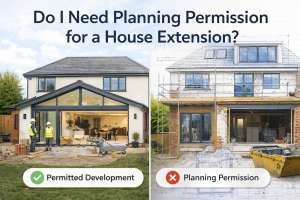
Understanding the difference between planning permission and permitted development can help you avoid delays, reduce risk and ensure your project moves forward smoothly.
What Is Planning Permission?
Planning permission is formal approval from your local planning authority allowing you to build or alter a property.
Local councils review applications to ensure the proposed development:
-
Fits within the surrounding area
-
Does not negatively affect neighbours
-
Meets local planning policies
-
Maintains acceptable design standards
If an extension requires planning permission, you must obtain approval before construction begins.
Understanding when planning permission for a house extension is required is one of the most important early steps when planning a home improvement project.
You can find more information about the planning system from the UK Government planning guidance here: https://www.gov.uk/planning-permission-england-wales
When Planning Permission Is Not Required
In many cases, homeowners can build extensions without submitting a planning application. This is because some works fall under Permitted Development rights.
Permitted Development allows certain building works to be carried out automatically, provided they stay within strict limits.
Typical examples include:
-
Small rear extensions
-
Single-storey side extensions
-
Loft conversions within size limits
-
Minor external alterations
However, these rights come with detailed rules covering:
-
Maximum extension depth
-
Height restrictions
-
Materials used
-
Distance from boundaries
If these limits are exceeded, planning permission will usually be required.
Situations Where Planning Permission Is Usually Required
Even if an extension seems small, planning permission may still be necessary in some circumstances.
Common examples include:
Large Extensions
If the proposed extension exceeds permitted development limits for depth, height or width, a planning application will normally be required.
Properties in Special Areas
Planning rules are stricter in certain locations such as:
-
Conservation areas
-
National Parks
-
Areas of Outstanding Natural Beauty
These locations often have reduced or removed permitted development rights.
Listed Buildings
Listed buildings require Listed Building Consent for most alterations, including extensions.
Flats and Maisonettes
Permitted Development rights generally apply only to houses, not flats or maisonettes.
When Planning Permission House Extension Approval Is Required
In some situations, planning permission house extension approval is required. For example, this can happen if the extension is too large or too close to a boundary. It may also apply if the property is in a conservation area or an Area of Outstanding Natural Beauty. In addition, flats and maisonettes do not have permitted development rights. Because of this, they usually require planning approval for extensions.
Why Many Homeowners Apply for a Lawful Development Certificate
Even when planning permission is not required, many homeowners still apply for a Lawful Development Certificate (LDC).
An LDC confirms that a proposal falls within permitted development rules.
Benefits include:
-
Proof the extension is lawful
-
Fewer issues when selling the property
-
Greater certainty before building work begins
This can provide peace of mind for both homeowners and future buyers.
How Good Design Helps Avoid Planning Issues
One of the most effective ways to reduce planning risk is through careful design.
Well-considered extensions typically:
-
Respect neighbouring properties
-
Maintain appropriate scale and proportions
-
Use materials that suit the existing house
These factors can significantly improve the chances of approval if a planning application is required.
If you are considering extending your home, professional design advice can help avoid costly mistakes and delays. You can learn more about my Architectural Services for home extensions and residential alterations here: Architectural Services.
Planning Permission vs Permitted Development
If you are unsure whether your project requires approval, it is helpful to understand the difference between these two systems.
You can read a detailed explanation here:
Permitted Development vs Planning Permission Explained
Related articles:
Final Thoughts
So, do you need planning permission for a house extension?
The answer depends on the size and type of extension and whether it falls within permitted development limits. While some projects can proceed without formal permission, others will require approval from the local planning authority.
Understanding these rules early in the process can save time, reduce risk and help ensure your project progresses smoothly.
If you are unsure about planning permission house extension rules, professional advice can help. An experienced architectural service provider can quickly check whether your project needs planning approval. They can also confirm if the work falls within permitted development. As a result, you can move forward with confidence and avoid planning problems later.
If you are planning an extension and want practical advice on layout, buildability, and cost control, professional guidance can make the process far easier.
Book your initial consultation with Alan now – just call 07590 563823 during office hours or email us today! or you can complete this form – we will be in touch very shortly.